I work the importer side of EU–Central America trade, and a EUR.1 certificate crosses my desk the way it crosses anyone’s: as a claim we mostly take on trust until a verification request forces the question. I spent some time going through the Association Agreement on a coffee problem recently, and the result is worth checking against your own files if you bring in roasted or instant coffee from Spain or Portugal under preferential treatment.
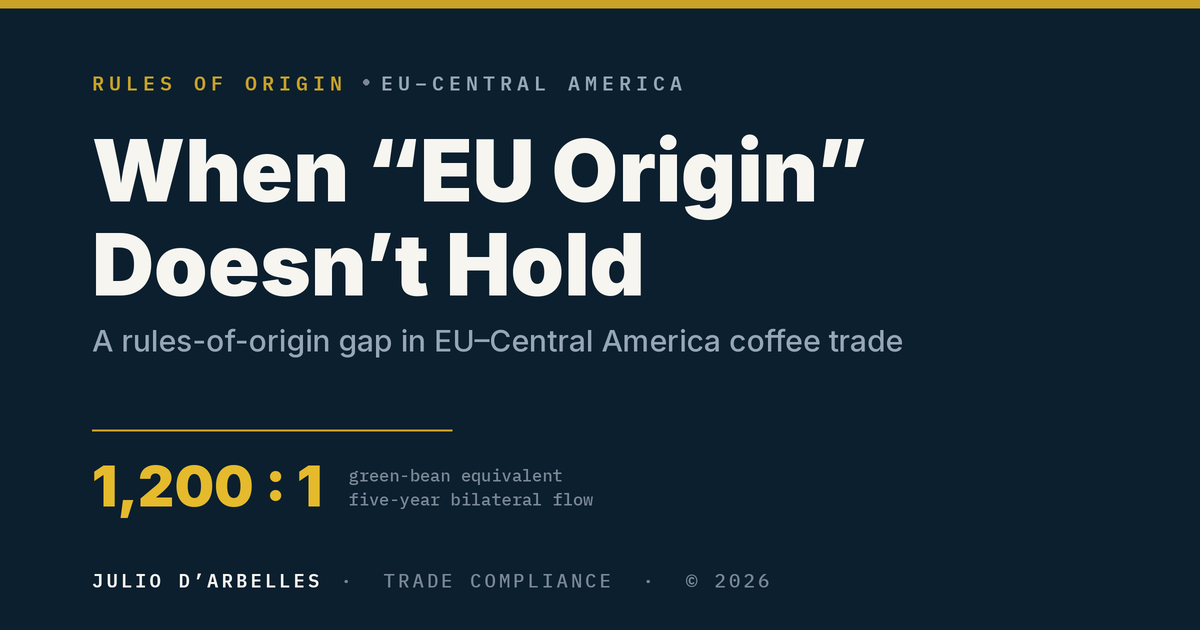
Start with the arithmetic, because it frames the rest. The EU-27 consumes about 2.9 million tons of coffee a year. EU territory produces under 500 tons. That leaves a gap of roughly 99.98 percent, closed entirely by imports. Spain by itself brings in around USD 817 million in green coffee annually, and the sourcing map will be familiar: Vietnam near a third, Brazil about a quarter, Colombia close to eight percent, Uganda six, and the balance spread across other non-EU, non-Central-American origins. Central America, for its part, ships Iberia a marginal volume, on the order of USD 7 to 10 million a year.
The asymmetry runs deeper than the green bean. In its 2022 review of the Agreement, the WTO Committee on Regional Trade Agreements recorded that since entry into force in 2013, EU exports to Central America had grown 44 percent and Central American exports to the EU 96 percent. The relationship is structurally outbound for Central America, and coffee is one of the primary-sector lines the European Parliament’s own implementation reporting still lists among the region’s exports to the bloc. The EU does not send roasted coffee into Central America as an industrial flow; it sends machinery, chemicals and transport equipment. Which makes the volume of EU-origin coffee claims worth a second look on its own.
Now hold those numbers against what the Agreement actually requires.
The rule is binary
Annex II, Appendix 2 sets the origin rule for Chapter 09. For roasted and decaffeinated roasted coffee, the text reads: “manufacture in which all the materials of Chapter 09 used are wholly obtained.” For instant coffee and the preparations under heading 2101, the rule allows manufacture from materials of any heading except the product’s own, but still requires all coffee of heading 0901 to be wholly obtained.
Read together, the two rules collapse into a single requirement. For coffee roasted in Spain to qualify as EU-originating under a EUR.1 sent to Central America, the green bean underneath has to be wholly obtained in EU territory or, through bilateral accumulation, in a signatory Central American country. There is no de minimis for Chapter 09 inputs. No value-added option stands in for the wholly-obtained test. The rule is binary by design, and the design is the point.
The Andean door opens one way
The intuitive escape from that requirement is diagonal accumulation with the Andean countries. Colombia, Peru and Ecuador are serious producers, the EU has its own agreement with them, and the EU–Central America text references them in its origin provisions. It feels like the door should open.
It opens in one direction only. Article 3 of Annex II lets Andean materials count as Central American when they are processed into a product obtained in Central America. The European Commission’s Access2Markets description runs the same way. Colombian green coffee roasted in Spain does not turn into EU-origin coffee for the certificate that travels back to Central America. The accumulation flows from the Andean region into the Central American manufacturing process, never from the Andean region into the European one. So the workaround most commonly assumed in practice does not survive a literal reading of the text.
Two further flexibilities people reach for fail for the same structural reason. The general tolerance rule does not reach wholly-obtained agricultural inputs. And the fungible-materials provision (accounting segregation, the mechanism that in other EU agreements lets a manufacturer commingle originating and non-originating stock and account for origin rather than physically separating it) is not available here in the form it takes under the EU–Mexico, EU–Japan, EU–UK or PEM frameworks. For a commodity that moves in bulk and gets blended as a matter of course, the absence of a usable fungibles mechanism is not a drafting footnote. It is the gap itself.
Why this is live in 2026
None of it would matter much if origin verification sat idle. It does not, and the pressure is converging from several directions. The EU Deforestation Regulation (2023/1115) already pushes geolocation requirements up the coffee supply chain. The EU’s accession to the International Coffee Agreement 2022 moved through Council in early 2026. Add the corporate due-diligence regime and the Forced Labour Regulation, and what a EUR.1 declares now has to line up with what a separate due-diligence statement says about the same beans. Those documents were drafted by different teams for different regulators. They are about to be read side by side.
There is a calendar to watch as well. The Agreement runs through Association Councils; the second one for Central America falls in the 2027 window, fed by technical sub-committees, including the Sub-Committee on Customs, Trade Facilitation and Rules of Origin. That body is where any amendment to Annex II would be prepared. If the fungibles gap is ever closed, that is where it happens.
What an importer can do now
Before an Article 30 verification request arrives, a few practical steps, in rough order of urgency. Get the supplier’s origin declaration in writing, and keep the supporting chain behind it, not just the EUR.1 on its own. Look hard at whether your roasted-coffee lines actually rely on the bilateral-accumulation door or on an Andean assumption that does not hold; if it is the latter, the exposure is quantifiable, not theoretical. And reconcile the origin claim against the EUDR and due-diligence paper trail before a regulator does the reconciling for you. The underlying figures are public and easy to pull: SIECA for the regional flows, ICO conversion factors to put roasted and green coffee on the same basis, UN Comtrade for the Iberian import picture.
I want to be clear about what this is and is not. It is not an allegation that a given shipment was misdeclared. Plenty of EU coffee exports to the region are small in volume and may clear the bilateral test on their own facts. It is an observation that a whole class of origin claims rests on a reading of Annex II the text does not actually support, while the surrounding regulation tightens at the same time. The arithmetic does not close on its own. Right now the person left to close it is the importer holding the certificate.
If you work EU–Central America coffee and want to compare notes on how you are documenting the wholly-obtained test, I would welcome the exchange.
Sources: SIECA; International Coffee Organization (conversion factors); UN Comtrade; European Commission Access2Markets; WTO Committee on Regional Trade Agreements (2022 review); European Parliament implementation reporting; EU–Central America Association Agreement, Annex II.
Download attachments: